
Grief & Bereavement Counselling in Langley & Vancouver
Loss changes everything. The world keeps moving, but something fundamental in you has shifted, and no amount of advice or positive thinking makes that less true. At Lavender Counselling, we don’t rush your grief or try to fix it. We walk alongside you, helping you find your own way through.
Serving Langley and the Lower Mainland since 2012
Grief, Loss & Bereavement
People talk about grief like it follows a straight line. Five stages, a timeline, some kind of finish line where you’re “over it.” But that’s not how it actually works. Grief is disorienting. It comes in waves that don’t always make sense. Fury one moment, numbness the next, laughter that catches you off guard and then guilt for laughing at all.
You’ve probably heard “they’re in a better place,” or “it gets easier,” or even “you need to stay strong.” And maybe part of you knows those words come from a good place. But knowing that doesn’t help when you’re lying awake at 3 a.m. wondering how you’re supposed to carry this.
Here’s what we believe at Lavender Counselling: grief isn’t a problem to solve. It’s a deeply human response to losing someone or something that mattered to you. Our job isn’t to hurry you through it or hand you a set of coping strategies and send you on your way. We’re here to sit with you in it, to help you understand what your grief is telling you, to make space for the parts of loss that don’t fit neatly into conversation, and to support you as you figure out how to carry this and still build a life that feels meaningful.

We provide grief and bereavement counselling at our offices in Langley, at our Vancouver location, and through secure virtual sessions across British Columbia. Whether your loss is recent or something you’ve carried for years, our team can meet you where you are.
Challenges We Help With
The Emotional Weight
- Waves of sadness that come without warning, at the grocery store, in the car, during a meeting
- Anger you weren’t expecting and don’t know what to do with
- Guilt about things said or unsaid, done or left undone
- A flatness or emotional numbness that makes the world feel distant
- Anxiety about the future and how you’ll manage without the person you lost
How Grief Lives in Your Body
- Exhaustion that sleep doesn’t fix
- Tightness in your chest or a physical heaviness that won’t lift
- Appetite changes, nothing sounds good, or food is the only comfort
- Trouble sleeping, or sleeping too much and still feeling drained
- Getting sick more often or feeling generally run down
When Daily Life Feels Impossible
- Struggling to concentrate at work or make even basic decisions
- Avoiding places, songs, or routines that remind you of your loss
- Going through the motions but feeling disconnected from everything
- Losing track of time or forgetting things that normally come easily
- Difficulty finding motivation to do things that used to matter
What Grief Does to Relationships
- Feeling misunderstood by friends and family who’ve “moved on”
- Withdrawing from people because socializing takes more than you have
- Tension with partners or family members who grieve differently
- Not knowing how to talk about your loss without making others uncomfortable
- Resentment toward people who still have what you’ve lost
Types of Loss We Support
- Death of a partner, parent, child, sibling, or close friend
- Pregnancy loss, miscarriage, and stillbirth
- Loss of a pet
- Anticipatory grief, when someone you love is dying
- Ambiguous loss, estrangement, disappearance, dementia, or when someone is physically present but emotionally or cognitively gone
- Loss of identity, health, career, relationship, or a future you’d planned for
- Grief that shows up years later, seemingly out of nowhere
How We Support Grief, Loss & Bereavement
We approach every person and every story as unique, because grief is exactly that. There’s no universal timeline and no correct way to do this. What works for one person may feel completely wrong for another, and that’s not a failure. It just means your grief is yours, and our work together needs to reflect that.
Get to Know the Problem
Your early sessions are about creating a space where you can actually talk about what happened, without performing, without editing, without worrying about being “too much.” We want to understand your loss in all its complexity. Not just what happened, but what it means to you, what it’s taken from your life, and what you’re still carrying.
“Grief needs a witness. Not someone to fix it , just someone willing to sit in it with you.”
Assess the Root Cause
Loss rarely exists in isolation. Sometimes grief stacks. A recent death cracks open older losses you thought you’d dealt with. Sometimes the hardest part isn’t the loss itself but the secondary losses that come with it: the future you’d imagined, the role you played in that person’s life, the version of yourself that existed before. We look at the full picture, not just the event.
“We often find that grief isn’t just about one loss. It’s about everything that loss touches.”
A Whole-Person Approach
Grief doesn’t just happen in your head. Research consistently shows that bereavement affects the body in measurable ways, disrupted sleep, elevated cortisol and inflammatory markers, immune suppression, and in some cases, genuine cardiovascular effects (sometimes called “broken heart syndrome”). Your body is processing this too, even when you’re not consciously thinking about it. That’s why our counsellors may integrate somatic awareness and body-centred approaches into grief work, paying attention to where loss lives in your body, not just the stories your mind tells about it.
“When we make room for grief in the body, something shifts. There’s space to breathe again.”
Our Approach Helps You:
✓ Process your loss without being pushed toward a timeline you didn’t choose
✓ Understand the complicated emotions grief brings, including the ones that feel “wrong”
✓ Reconnect with your body and address the physical weight of loss
✓ Navigate relationships and social situations while you’re grieving
✓ Find meaning and build a life that honours what you’ve lost without being defined by it
Our Grief Counselling Team
Our team includes registered clinical counsellors who work with grief, loss, and bereavement. Each brings unique training and expertise in evidence-based modalities including:
- Attachment-based and emotion-focused therapy
- Trauma-informed and person-centred approaches
- Somatic and body-centred practices
- Experiential therapies (including AEDP and Focusing)
- Mindfulness and self-compassion frameworks
Our therapists works with:
- Children (ages 5-12, Langley offices only), tweens, teens, and adults
- All types of loss: death, ambiguous loss, anticipatory grief, pregnancy loss, pet loss, and non-death losses
- Complex or prolonged grief, as well as recent and acute loss
- Individuals navigating cultural, spiritual, or family-specific grief practices
Find Your Grief Counsellor
The right therapeutic relationship matters especially in grief work, where you need to feel genuinely safe to go to the hard places. Use our therapist selector tool to find counsellors whose expertise, approach, and availability match what you’re looking for.
Why Choose Lavender Counselling For Grief & Bereavement?
Relational, Person-Centered Approach
Bottom-Up, Body-Based Support
Find Your Perfect Fit
Consistent, Quality Care
No Artificial Timelines
Flexible Access
Insurance Coverage
Deep Community Roots
What To Expect In Grief Counselling

Your First Session
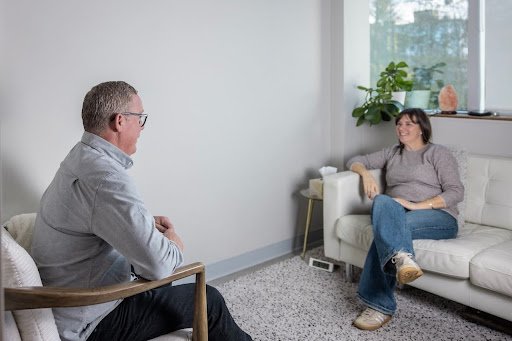
Your first appointment is really about two things: helping us understand what brought you here, and helping you get a sense of whether this feels like the right space. We’ll ask about your loss, how you’ve been coping, and what’s been hardest. But we also want to know about you, your life, your relationships, what matters to you. There’s no pressure to share everything right away. We go at your pace.
Our Collaborative Approach
Grief work looks different for everyone. Some people need to tell their story over and over before it starts to settle. Others need help with the practical chaos that loss creates, the decisions, the changed routines, the social situations they’re dreading. Some come in because they can’t cry and worry something is wrong with them. Whatever your experience, we build our approach around what you need, adjusting as that changes. Because it will change.

Confidentiality
Everything you share remains confidential within legal and ethical boundaries. Your counsellor will walk through all of this in your first session so there are no surprises. This is especially important in grief work, where you might need to express things, anger, relief, complicated feelings about the person you lost, that you wouldn’t say anywhere else. Our counsellors create a space where the full truth of your experience is welcome.

Flexible, Ongoing Support
Some clients come weekly in the early days, then space out sessions as they find their footing. Others check in monthly for ongoing support through anniversaries, holidays, or unexpected waves. There’s no formula here. We work with you to figure out what rhythm makes sense, and we adjust as your needs shift.
Frequently Asked Questions
There’s no threshold you need to cross. If your grief is affecting your daily life, your relationships, or your sense of self, or if you just need someone to talk to who isn’t going to tell you to look on the bright side, that’s enough. Some people come to us days after a loss. Others come years later, surprised that it’s still affecting them. Both are valid.
Most grief, even when it’s intense and disorienting, is a natural response to loss. Prolonged grief disorder is a clinical term for when grief remains so consuming over an extended period that it significantly impairs your ability to function, months or years after the loss, with no movement or relief. That said, we’re cautious about pathologizing grief. Even “normal” grief can be devastating and deserve support. You don’t need a diagnosis to benefit from counselling.
A lot of grief counselling focuses on stage-based models or structured interventions designed to move you through grief efficiently. We take a different approach. We work relationally, meaning the therapeutic relationship itself is part of the healing process. We don’t push timelines or protocols. And we pay attention to how grief shows up in your body, not just your thoughts. It’s slower, more personalized, and built around you.
There’s no set number of sessions. Some people feel meaningfully supported after a handful of sessions. Others continue for months or years, especially around complex loss. We don’t impose timelines, you and your counsellor decide together what makes sense, and you can step away and come back whenever you need to.
Yes. We offer secure virtual counselling throughout British Columbia. Many of our clients find that virtual sessions work well for grief work. You can be in your own space, which sometimes makes it easier to access difficult emotions. We also offer in-person sessions at our Langley and Vancouver offices if you prefer that.
That happens, and it’s completely fine. The therapeutic relationship is the foundation of this work, and if it doesn’t feel right, it won’t be effective. Let us know and we’ll help you connect with another counsellor, no hard feelings, no questions asked. That’s why we offer the free initial consultation: to give you a chance to feel things out before committing.
Not even close. Grief doesn’t expire. It’s very common for people to seek support years, sometimes decades after a loss. Maybe something has shifted in your life that’s brought it back to the surface. Maybe you never really had the chance to process it. Whatever brought you here now, you’re not too late.
Absolutely. Grief isn’t limited to death. The end of a relationship, losing your health, a career change, estrangement from a family member, moving away from a community, these are real losses that deserve real support. Our counsellors work with all forms of grief and loss.
Yes. We have counsellors who work with children (ages 5-12 at our Langley offices), tweens, and teens navigating loss. Grief looks different at every age, and our team adapts their approach accordingly, meeting younger clients where they are developmentally while still honouring the weight of what they’re going through.
No, and we wouldn’t promise that. Grief is the cost of loving someone, and it doesn’t fully disappear. But counselling can help you carry it differently. It can ease the isolation, help you make sense of confusing emotions, and support you in building a meaningful life that holds both your loss and your future.