MAID Counselling in Langley
Navigating Medical Assistance in Dying brings up emotions that don’t fit neatly into categories, grief before loss has happened, relief tangled with guilt, love expressed through letting go. You don’t have to hold all of that alone. Our counselling provides a grounded, compassionate space for individuals and families at every stage of the MAID journey.
Serving Langley and the Lower Mainland since 2012
Medical Assistance in Dying (MAID)
There’s no roadmap for this. Whether you’re the one considering MAID, or you’re walking alongside someone you love who’s made that choice, the emotional terrain is unlike anything most people have experienced before. You might feel a deep sense of peace about the decision one moment and be levelled by grief the next. You might feel angry at the illness, at the system, at the unfairness of it all. You might feel relief and then feel guilty for feeling relief.
And most people around you probably don’t know what to say. MAID is still new enough in our culture that many friends, family members, even some healthcare providers aren’t sure how to talk about it. That isolation, feeling like you can’t be fully honest about what you’re going through can be one of the hardest parts.
At Lavender Counselling, we don’t see your emotions around MAID as something to manage or push through. They’re a natural response to an extraordinary situation. Our role isn’t to guide you toward any particular feeling or decision. It’s to sit with you in the full complexity of what you’re experiencing, the contradictions, the uncertainty, the love underneath all of it, and help you find your own way through.

We offer MAID counselling in-person at our Langley offices and virtually throughout British Columbia. Whether you’re in the early stages of considering MAID, supporting a loved one through the process, or grieving after a MAID death, we’re here.
Challenges We Help With
Emotional Weight of the Decision
- Feeling torn between supporting a loved one’s autonomy and your own grief about losing them
- Guilt about feeling relieved, about not being able to “fix” the illness, about your own emotions taking up space
- Anticipatory grief that hits before the loss has even happened
- Feeling pressure to be “strong” or “supportive” when you’re barely holding it together yourself
- Anger, frustration, or a sense of injustice related to the limitations of their illness or the decision that has been made
Navigating Family and Relationships
- Family members who disagree about MAID or refuse to discuss it
- Strain between wanting to honour your loved one’s wishes and your own pain about those wishes
- Feeling isolated because friends or extended family don’t understand or approve
- Difficulty knowing what to say to the person dying, to children in the family, to each other
- Feeling invalidated when others fail to understand or acknowledge the significance and impact of this type of loss
Living with Loss After MAID
- Grief that doesn’t follow the patterns people expect, because this death didn’t follow typical patterns either
- Feeling like you can’t talk openly about how your loved one died
- Replaying the day or the days leading up to it
- Struggling with others’ judgments or discomfort about MAID
- Relief mixed with profound sadness, and not knowing what to do with either
- Experiencing anger and frustration, especially in response to feelings of powerlessness
The Person Considering MAID
- Exploring all end-of-life options and wanting a safe, non-directive space to think through what feels right for you
- Processing the weight of the decision itself, even when you feel certain
- Wanting space to talk through fears, hopes, and unfinished emotional business
- Grief about what you’re leaving behind
- Navigating how to talk with family members about your choice
How We Support MAID Counselling
We approach every person and every story as unique. MAID touches on some of the most fundamental human experiences, love, loss, mortality, autonomy, and what it means to care for someone. There’s no formula for this work. Here’s how we begin.
Get to Know the Problem
Before anything else, we listen. We want to understand where you are — not just the facts of the situation, but how you’re carrying it. What feels heavy. What feels unspeakable. What feels like it has nowhere to go.
Understand What’s Underneath
MAID often surfaces emotions and relational patterns that go beyond the immediate situation. Old grief can get stirred up. Long-standing family dynamics can intensify. The experience can bring up fundamental questions about meaning, mortality, and what matters most. We help you make sense of what’s being activated, not to analyze it away, but to give you more room to breathe.
Working With the Body’s Response
End-of-life experiences register deeply in the body. Research on anticipatory grief consistently identifies physical symptoms, disrupted sleep, appetite changes, muscle tension, a persistent heaviness or numbness, as core features of the grief process, not secondary ones. The body carries what words sometimes can’t.
That’s why we may incorporate body-aware approaches alongside talk therapy. This might look like noticing where tension or emotion sits physically, working with breathing to regulate your nervous system when things feel overwhelming, or simply learning to recognize your body’s signals when it’s telling you it needs rest, expression, or support.
Our Approach Helps You:
✓ Process the complex, often contradictory emotions that come with MAID, without judgment or pressure to feel any particular way
✓ Navigate difficult family conversations and relational dynamics with more grounding and clarity
✓ Develop ways to care for yourself during an emotionally demanding time
✓ Find language for experiences that can feel impossible to put into words
✓ Begin to integrate loss, whether that’s anticipatory grief or bereavement after a MAID death
Our Counselling Team
We have a registered clinical counsellor who works with individuals and families navigating Medical Assistance in Dying. She brings training and experience in trauma-informed, person-centred, and strength-based modalities, incorporating mindfulness and self-compassion into her work.
Our counsellor works with:
- Adults considering or pursuing MAID
- Partners, spouses, and family members of someone who has chosen MAID
- Individuals grieving after a MAID death
- People processing complex or conflicted feelings about a loved one’s MAID decision
Find Your MAID Counsellor
Given the deeply personal nature of this work, the right therapeutic relationship matters enormously. Use our therapist selector tool to learn more about our counsellor’s approach and availability, and to book a free consultation to see if it’s a good fit.
Why Choose Lavender Counselling for MAID?
Relational, Person-Centered Approach
Body-Aware Support
Find Your Perfect Fit
No Artificial Timelines
Flexible Access
Insurance Coverage
Deep Community Roots
What To Expect In Maid Counselling

Your First Session
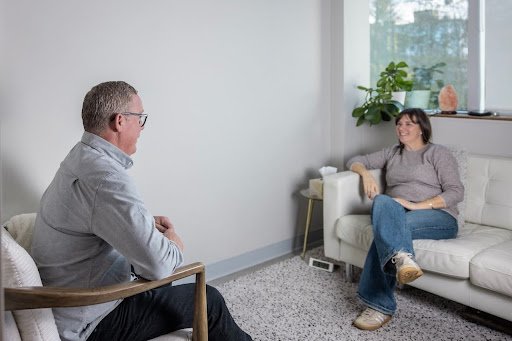
We start by getting to know you and what brought you here. We want to hear your story, where you are right now, what’s weighing on you, and what kind of support would actually help. If you cry, that’s fine. If you’re numb, that’s fine too. There’s no wrong way to show up.
Our Collaborative Approach
This isn’t a one-size-fits-all program. How we work together depends entirely on where you are in the MAID journey and what you need. For some people, that’s help processing an upcoming decision. For others, it’s navigating family conflict. For some, it’s grief that arrived months or years after a MAID death and won’t seem to settle. We adapt as your needs change, because they will.

Confidentiality
Everything you share remains confidential within legal and ethical boundaries. Your counsellor will walk through all of this in your first session so there are no surprises. This can be especially important in MAID work, where you may need space to express feelings you’re not comfortable sharing with family, doubt, anger, relief, fear, without worrying about how it will land.

Flexible, Ongoing Support
Some clients come weekly. Others come biweekly or on an as-needed basis. Some people find a few sessions before or after the MAID provision is enough. Others want ongoing support over months. We’ll find the rhythm that works for you, and adjust it whenever you need to.
Frequently Asked Questions
Right, we don’t perform MAID eligibility assessments or provide the medical procedure. That’s done by physicians and nurse practitioners through BC’s health authorities. What we offer is emotional and relational support for individuals and families navigating the MAID experience, provided in accordance with Canadian law and professional ethical guidelines, and focused on emotional health and informed exploration of all options. That can include processing the decision, managing anticipatory grief, working through family dynamics, and bereavement support after a MAID death. If you need help connecting with the medical MAID process in BC, Fraser Health’s MAID Care Coordination Centre can be reached at 604-587-7878 or mccc@fraserhealth.ca.
Absolutely. Even when you feel clear about your decision, there’s often a lot of emotional weight that comes with it like things you want to say to people, fears about the process, grief about what you’re leaving behind. Counselling gives you a private space to process all of that without worrying about how your emotions might affect the people around you.
Yes. Supporting a loved one through MAID can bring up an incredibly complex mix of emotions, wanting to honour their choice while grieving deeply, feeling relief alongside sadness, dealing with family members who see things differently. You don’t need to have it figured out before you come in. That’s what the work is for.
It depends entirely on your situation. Some people come for a handful of sessions around a specific point in the MAID process. Others continue for months as they work through bereavement. There’s no set number of sessions and no pressure to commit to a particular timeline.
Yes. We offer virtual counselling to anyone in British Columbia. In-person sessions are available at our Langley offices.
Not at all. Grief from a MAID death can be complicated by things like social stigma, unresolved family conflict, or simply the uniqueness of the experience. There’s no expiry date on getting support. Many people find that the grief shifts and resurfaces over time, and counselling can help whenever it does.
Research suggests that overall bereavement outcomes after MAID are generally comparable to other types of death. But the experience can feel different. Knowing the date in advance creates a unique kind of anticipatory grief. Some people feel relief mixed with loss, and that combination can be confusing. Family disagreements about MAID can complicate mourning. And the relative newness of MAID in Canadian culture means there are fewer established rituals or shared frameworks for processing it. All of that is worth having support around.
No. You can reach out to us directly. No referral, no doctor’s note, just a phone call or email to get started.
If it’s taking up space in your mind and affecting how you’re living, it’s enough. MAID touches on some of the most profound human experiences there are. You don’t need to be in crisis to deserve support. And frankly, earlier is usually better than later when it comes to this kind of emotional weight.