
Men’s Issues Counselling in Langley
You don’t need to have it all figured out to reach out. Whether you’re carrying more than you let on, struggling with relationships, or just feeling stuck, counselling can give you a space where you don’t have to perform or pretend. We’re here to help you make sense of what’s going on, at your own pace.
Serving Langley and the Lower Mainland since 2012
Men’s Issues
Many men weren’t taught how to talk about what’s going on inside. You might notice it as a tightness in your chest that won’t quit, a short fuse you can’t explain, or restlessness, like something’s off but you can’t point to what. Maybe you’re going through the motions at work and at home, checking boxes but feeling hollow. Or maybe things have reached a point where the stuff you used to push through just isn’t staying down anymore.
Maybe you’ve tried the usual advice. Exercise more. Think positive. Talk to a friend. And look, those things aren’t wrong. But sometimes there’s more beneath the surface and powering through this is just a short-term solution. This isn’t a character flaw and it doesnt mean you’re a failure.
At Lavender Counselling, we don’t see what you’re going through as a problem to fix or a weakness to overcome. We see it as your system trying to tell you something important. Our approach is relational and person-centred, meaning we start with you, not a checklist of symptoms. We’re interested in what’s driving the surface-level stuff: the anger, the withdrawal, the exhaustion, the numbness. And we work with you to understand it, not just manage it.

We offer men’s issues counselling at our Langley offices, with virtual sessions available throughout British Columbia. Whether you prefer to meet in person or connect online, we’ll find what works for you.
Challenges We Help With
Emotional & Internal Struggles
- Feeling numb, disconnected, or like you’re just going through the motions
- Anger that flares up fast and feels disproportionate to the situation
- A persistent sense of restlessness or dissatisfaction you can’t explain
- Difficulty identifying or putting words to what you’re actually feeling
- Shame or self-criticism that you carry quietly
Relationship & Connection
- Feeling emotionally distant from your partner, even when things look fine from the outside
- Struggling to be vulnerable or open up, and not really knowing how
- Conflict patterns that keep repeating no matter what you try
- Difficulty maintaining close friendships as an adult
- Navigating separation, divorce, or co-parenting challenges
Work, Identity & Purpose
- Burnout that rest alone doesn’t fix
- Pressure to provide, succeed, or “have it together” at all times
- Questioning your career, direction, or what you actually want from life
- Feeling like your identity is wrapped up in what you do rather than who you are
- Navigating retirement or life transitions without a clear sense of purpose
Fatherhood & Family
- Struggling with the pressures and expectations of fatherhood
- Feeling unsure of your role as a parent or partner
- Navigating blended families or custody situations
- Wanting to break patterns from how you were raised but not knowing where to start
Societal & Cultural Pressures
- Growing up with messages like “man up” or “boys don’t cry” that still affect how you handle things
- Feeling isolated because asking for help feels like admitting defeat
- Navigating masculinity, what it means to you versus what you were told it should mean
- Cultural or family expectations around what men should be or do
Physical & Behavioural Patterns
- Using alcohol, substances, work, screens, or sex to numb or avoid
- Sleep problems, either can’t shut your brain off or sleeping too much
- Physical tension, headaches, or stomach issues with no clear medical cause
- Withdrawing from people and activities you used to enjoy
- Risk-taking behaviour or recklessness that feels out of character
How We Support Men’s Issues
We approach every person and every story as unique. There’s no script for this, and we don’t believe in one-size-fits-all solutions. What we do believe is that the therapeutic relationship, the trust between you and your counsellor is where the real work happens. Here’s what that looks like in practice.
Get to Know the Problem
Before we try to change anything, we need to understand what’s actually going on. That means creating a space where you can be honest, about what’s working, what isn’t, and what you’ve been carrying. For a lot of men, this is the first time anyone’s asked them to slow down and actually look at what’s underneath.
“Most men have been solving problems their whole lives. Counselling isn’t about solving — it’s about understanding what the problem is actually about.”
Assess the Root Cause
The things that bring men into counselling, anger, withdrawal, relationship breakdowns, burnout, are usually the visible part of something deeper. We look at the patterns: how you learned to cope, what you were taught about emotions growing up, the experiences that shaped how you move through the world. We’re not interested in surface-level fixes.
“What looks like a communication problem in your relationship might actually be about something you learned to do with your feelings a long time ago.”
Treat From the Bottom Up
Research in emotion regulation consistently shows that emotional suppression, something many men have practised since childhood creates real physiological effects. Chronic muscle tension, elevated stress hormones, disrupted sleep, and cardiovascular strain are well-documented consequences of long-term emotional avoidance. That’s why we may incorporate body-based approaches alongside traditional talk therapy. When stress and difficult emotions have been held in the body for years, talking alone may not be enough to shift them.
“Sometimes the conversation your body needs to have is different from the one happening in your head.”
Our Approach Helps You:
✓ Develop the ability to identify and express what you’re feeling without losing yourself in it
✓ Build stronger, more honest connections in your relationships
✓ Break patterns of withdrawal, avoidance, or numbing that aren’t serving you
✓ Understand the roots of anger, stress, or dissatisfaction rather than just managing symptoms
Our Counselling Team
Our team includes registered clinical counsellors who work with men’s issues. Each brings unique training and expertise in evidence-based modalities including:
- Person-centred and humanistic therapy
- Attachment-based and emotion-focused approaches
- Trauma-informed, body-centred practices
- Somatic awareness and mindfulness-based approaches
- Experiential and relational therapy
Our therapists works with:
- Teens, young adults, and adults across the lifespan
- Men navigating relationship, identity, and career challenges
- Fathers and men working through family-of-origin patterns
- First responders, veterans, and men in high-pressure roles
- Men from diverse cultural backgrounds and life experiences
Find Your Men’s Issues Counsellor
The right therapeutic relationship is essential for this kind of work. A lot of men have had the experience of trying to open up and feeling like it went nowhere, or worse, feeling judged. That’s why fit matters so much. Use our therapist selector tool to find counsellors whose expertise, approach, and availability match what you’re looking for.
Why Choose Lavender Counselling for Men’s Issues?
Relational, Person-Centered Approach
Bottom-Up, Body-Based Support
Find Your Perfect Fit
Consistent, Quality Care
No Artificial Timelines
Flexible Access
Insurance Coverage
Deep Community Roots
What To Expect In Men’s Issues Counselling

Your First Session
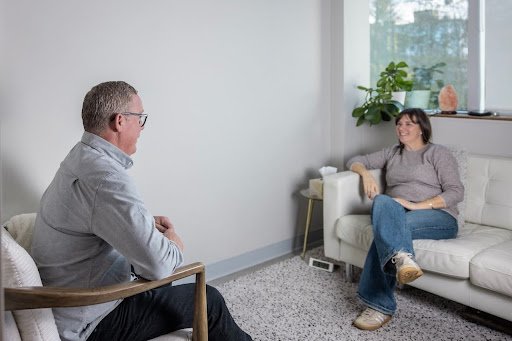
Your first session is really about getting to know each other. Your counsellor will want to hear what brought you in, not a rehearsed version, just whatever feels true. They’ll ask some questions about your history, your current situation, and what you’re hoping to get out of this. There’s no pressure to share everything at once. Most men feel a mix of relief and awkwardness in the first session, and that’s completely normal.
Our Collaborative Approach
This isn’t something that’s done to you, it’s something we do together. Your counsellor won’t sit there nodding and saying nothing, and they also won’t tell you what to do. It’s a conversation. Over time, you and your counsellor will develop a shared understanding of what’s going on and what you want to work toward. Goals might shift as you go, and that’s fine. The process is meant to be flexible enough to follow where things actually need to go.

Confidentiality
Everything you share remains confidential within legal and ethical boundaries. Your counsellor will walk through all of this in your first session so there are no surprises. For men who’ve held things close their whole lives, knowing that this space is genuinely private can make a real difference.

Flexible, Ongoing Support
Some men come weekly. Some come every other week. Some come intensively for a stretch and then step back. There’s no prescribed frequency, we figure out together what makes sense for where you are. And if things change in your life, we adjust.
Frequently Asked Questions
Not at all. “Men’s issues” is a broad term that covers the specific pressures, expectations, and emotional patterns that many men deal with, things like difficulty expressing emotions, relationship strain, identity questions, burnout, and the effects of growing up with messages about what men “should” be. It’s not a diagnosis. It’s a recognition that men often face particular challenges that benefit from a space where those challenges are understood.
A lot of men who come to counselling didn’t think of themselves as the therapy type either. You don’t need to be good at talking about feelings to start. That’s part of what we work on together. And our approach isn’t just sitting in a chair analysing your childhood (unless that’s what you need). It’s practical, relational, and adapted to how you actually process things.
Friends are great, but most friendships have limits around how deep or honest you can go. A counsellor offers something different: a trained, confidential, nonjudgmental space where you can say the things you wouldn’t say anywhere else. And unlike a friend, your counsellor isn’t going to change the subject, get uncomfortable, or give you advice based on their own experience.
It depends entirely on you, what you’re working through, how deep it goes, and what you’re hoping to achieve. Some men come for 8-10 sessions and feel like they’ve got what they need. Others stay longer because they find ongoing value in the process. We don’t set arbitrary endpoints or push you toward “graduation.” You decide when you’re done.
Yes. We offer secure virtual sessions throughout British Columbia. Many men actually prefer virtual counselling, it fits easier into a work schedule, there’s no commute, and for some, it feels less intimidating than walking into an office. The therapeutic work can be just as effective as online.
That’s okay, and it happens. The relationship between you and your counsellor is the most important factor in whether counselling works. If it doesn’t feel right, tell us. We’ll help you connect with someone else on our team. No hard feelings, no awkwardness. Getting the right fit matters more than sticking with the first person you meet.
Yes. Your counsellor is bound by professional ethical standards and provincial law to keep your sessions confidential. The only exceptions involve imminent risk of harm to yourself or others, or situations involving child welfare, and your counsellor will explain those limits clearly at the start.
If it’s affecting your life, your sleep, your relationships, your mood, your sense of purpose, it’s worth exploring. There’s no threshold you have to meet. A lot of men wait until things hit crisis level before reaching out, partly because they’ve been taught to push through. You don’t have to wait for a breakdown to deserve support.
Our men’s issues counselling is for anyone who identifies as a man, regardless of gender identity. We also have counsellors who work with gender identity and 2SLGBTQ+ concerns if that’s something you’d like to explore alongside or separate from men’s issues work.