Consensual Non-Monogamy Counselling in Langley & the Lower Mainland
When monogamy is often viewed as the standard in our society, stepping away from that framework can bring up all sorts of reactions in yourself and those around you. Whether you’re exploring consensual non-monogamy for the first time, are CNM curious, or are navigating the nuances that come with it, we meet you where you’re at with respect and acceptance.
Serving Langley and the Lower Mainland since 2012
Consensual Non-Monogamy
People come to consensual non-monogamy counselling for all kinds of reasons. Sometimes it’s a quiet sense that monogamy doesn’t quite fit, but you’re not sure what does. Maybe you’ve been reading, listening to podcasts, having late-night conversations, and you’re still not clear on what you actually want versus what you think you should want.
For others, it’s less about figuring preferences out and more about needing a space to be honest. Not everyone has people in their life they can talk to about this. Friends and family might not understand, and you might worry about being judged, labelled, or having your relationship dismissed as less serious. Feeling like you need to hide a part of yourself takes a toll, and that weight often goes unacknowledged.
Others come for counselling focused around particular challenges or concerns. Communication that keeps hitting the same wall. A boundary that felt clear initially, but got messy. Navigating jealousy or insecurity. Working through what it means when a partner develops deeper feelings for someone new. CNM relationships tend to ask more of you…more honesty, more self-awareness, and more communication. Most of us didn’t grow up with models for how to do these things well outside of a monogamous framework.
At Lavender Counselling, we don’t see consensual non-monogamy as a problem to solve or a phase to get through. We see it as a legitimate relationship choice that comes with its own set of real challenges. Our counsellors work from a place of genuine affirmation, not polite tolerance, and they understand the relational dynamics that come with polyamory, open relationships, relationship anarchy, swinging, and other consensual non-monogamous structures. The goal isn’t to make you fit a template. It’s to help you understand yourself and your relationships more deeply, so you can build something that actually works.

We offer in-person counselling at our Langley offices and virtual counselling throughout British Columbia, so you can access support wherever you are in the province.
Challenges We Help With
Jealousy, Envy & Emotional Triggers
- Intense jealousy that feels disproportionate to the situation — and the shame that follows it
- Envy toward a partner’s other connections
- Feeling blindsided by emotions you didn’t expect when an agreement is actually put into practice
- Struggling with comparisonitis, measuring yourself against other partners
Communication & Boundaries
- Having the same conversation about boundaries over and over without resolution
- Exploring communication skills and/or how to set boundaries
- Feeling like you’re always the one bringing up hard conversations
- Not knowing how to ask for what you need
- Navigating different communication styles across multiple relationships
Identity & Self-Worth
- Exploring preferences, desires, belief systems, and expectations
- Feeling like you’re “not poly enough” or doing it wrong
- Losing yourself in the logistics of managing multiple relationships
- Struggling with your sense of identity when your relationship structure doesn’t match what your family, friends, or culture expects
- Questioning whether consensual non-monogamy is right for you and/or whether you agreed to it for someone else
Relationship Dynamics & Conflict
- Power imbalances between partners, one person feeling like they have less say or fewer options
- Navigating a primary/secondary hierarchy that doesn’t feel fair to everyone
- Conflict between partners about time, energy, and emotional availability
- One partner wanting to open the relationship while the other doesn’t, or agreed reluctantly
- Repairing trust after a boundary violation or broken agreement
Social & Family Pressures
- Feeling isolated because you can’t be honest with friends or family about your relationships
- Managing the stress of being “out” as non-monogamous in some spaces but not others
- Dealing with judgment, assumptions, or unsolicited opinions from people in your life
- Worrying about the impact on children or co-parenting arrangements
- Moving through grief about non-acceptance from certain people in your life
Navigating Transitions
- Opening a previously monogamous relationship and not knowing where to start
- A partner developing deeper feelings for someone new, and what that means for your relationship
- Closing or restructuring a relationship within a polycule
- Processing a breakup
How We Support Consensual Non-monogamy
We approach every person and every story as unique. There’s no single blueprint for how consensual non-monogamous relationships should work, so there’s no single blueprint for how we support them. What we do bring is genuine curiosity, clinical skill, and a commitment to understanding your particular situation.
Get to Know the Problem
Before anything else, we want to understand what’s actually happening, not just the surface-level conflict, but the feelings and patterns underneath it. Sometimes what looks like a jealousy problem is really an attachment wound. Sometimes a communication breakdown is really about one partner not feeling safe enough to be honest. We take time to get the full picture.
“I didn’t realize how much of what I was feeling had nothing to do with my partner’s other relationship — and everything to do with what I believed I deserved.”
Assess the Root Cause
Many relationship struggles trace back to earlier experiences, how you learned to attach, what you absorbed about love and worthiness, what felt safe or threatening in your earliest relationships. We look at those roots, not to blame your past, but to help you understand why certain situations trigger such strong responses now.
“Once I understood where my fear of abandonment actually came from, I stopped blaming my partner for it — and we could finally have a real conversation.”
Treat From the Bottom Up
Strong emotional reactions in relationships, the gut-punch of jealousy, the freeze when a partner discloses something new, the anxiety that sits in your chest before a hard conversation, these aren’t just thoughts. They live in your body. Research on attachment and emotional regulation shows that our nervous system responds to perceived relational threats in ways that can override our best intentions and rational thinking. When your system is activated, no amount of talking through agreements or reading about compersion is going to land.
That’s why our counsellors may incorporate body-aware approaches where appropriate, helping you notice what’s happening in your body during triggering moments and build the capacity to stay present rather than shutting down or escalating. This isn’t about replacing conversation. It’s about making conversation actually possible.
“I used to completely shut down during hard conversations. Learning to notice what was happening in my body first — before I tried to find the words — changed everything.”
Our Approach Helps You:
✓ Develop self-awareness around your triggers, attachment patterns, and emotional responses within non-monogamous dynamics
✓ Build communication skills that go beyond scripts, real, honest conversation rooted in self-knowledge
✓ Navigate jealousy and insecurity with curiosity instead of panic
✓ Create relationship agreements that reflect what you actually need, not what you think you should need
✓ Navigate judgment and/or non-acceptance from yourself and others
✓ Move towards living authentically in the world
Our Counselling Team
Our team includes registered clinical counsellors who work with clients in consensual non-monogamous structures. Each brings unique training and experience in evidence-based modalities including:
- Person-centred and relational therapy
- Attachment-based approaches
- Emotion-focused therapy (EFT)
- Accelerated experiential dynamic psychotherapy (AEDP)
- Somatic awareness and body-centred practices
- Mindfulness and self-compassion frameworks
Our therapists work with:
- Teens and adults navigating consensual non-monogamous relationships or questioning their relationship orientation
- Individuals processing their own experience within a consensual non-monogamous dynamic
- Couples exploring or already practicing consensual non-monogamy
- People at any stage, from considering non-monogamy to experienced partners facing new challenges
Some of our counsellors also offer direct child counselling (ages 5-12) at our Langley offices, which can complement parent-focused work when appropriate.
Find Your Non-Monogamy Counsellor
The right therapeutic relationship is essential for this kind of work. You need someone who genuinely gets it, not a counsellor who’s going to subtly steer you back toward monogamy or treat your relationship structure as the problem. Use our therapist selector tool to find counsellors whose expertise, approach, and availability match what you’re looking for.
Why Choose Lavender Counselling for Consensual Non-Monogamy Support?
Relational, Person-Centered Approach
Bottom-Up, Body-Based Awareness
Find Your Perfect Fit
Consistent, Quality Care
No Artificial Timelines
Flexible Access
Insurance Coverage
Deep Community Roots
What To Expect In Consensual Non-monogamy Counselling

Your First Session
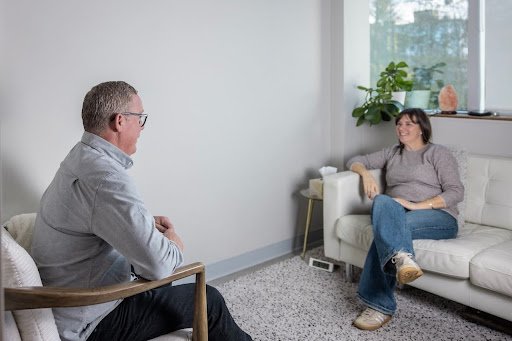
Your first session is about getting comfortable and helping your counsellor understand your world. We’ll ask about what brought you in, your relationship structure, and what you’re hoping to get out of counselling. There’s no pressure to have it all figured out, and there’s no part of your experience that’s off-limits or too complicated to bring into the room. A lot of people come in expecting to be judged. That won’t happen here.
Our Collaborative Approach
Counselling isn’t something that’s done to you. You and your counsellor work together to identify what’s getting in the way and figure out what support looks like for your particular situation. Some sessions might focus on processing difficult emotions. Others might be more practical, working through a communication challenge or thinking through a decision. It depends on what you need, session to session.

Confidentiality
Everything you share remains confidential within legal and ethical boundaries. Your counsellor will walk through all of this in your first session so there are no surprises. We know that being consensually non-monogamous involves layers of privacy that many people don’t have to think about, who knows, who doesn’t, what the consequences of disclosure might be. Your counsellor understands that and takes your privacy seriously.

Flexible, Ongoing Support
Some clients come weekly. Some come biweekly or monthly. Some come for a stretch, take a break, and come back when something new comes up. There’s no mandatory frequency or session count. We adapt to what works for you and your life.
Frequently Asked Questions
Not at all. Many of our clients come as individuals to work on their own experience within a non-monogamous relationship. That said, if you and a partner want to come together, we offer couples counselling too. You don’t have to do both, it depends on what feels right.
No. Our counsellors who work with non-monogamous clients are genuinely affirming of diverse relationship structures. They’re not going to treat consenual non-monogamy as a phase, a symptom, or something to move past. If your relationship structure is working for you, we’re here to support it. If you’re questioning it, we’re here to help you figure that out without pushing you in either direction.
A lot of couples counselling is built on monogamous assumptions, about exclusivity, about what commitment looks like, about what constitutes a “healthy” relationship. Our counsellors don’t bring those assumptions into the room. We work within the framework of your actual relationship, whatever shape it takes.
Yes. Figuring out what you actually want, as opposed to what you think you should want, is exactly the kind of thing counselling is good for. Your counsellor can help you explore that question without rushing you toward an answer.
It depends on what you’re working on. Some people come for a few months to work through a specific challenge, like opening a relationship or processing jealousy. Others stay longer because the work touches on deeper patterns. There’s no set number of sessions and we don’t push artificial timelines.
Yes. We offer virtual counselling throughout British Columbia. Many of our clients find that virtual sessions work well for this kind of relational work, and it means you’re not limited by geography when finding the right counsellor.
Tell us. The therapeutic relationship matters more than anything else, and we’d rather help you find the right person than have you push through with someone who doesn’t feel right. We offer a free consultation specifically so you can get a sense of fit before committing.
You don’t need to be in crisis to benefit from counselling. If something is weighing on you, even if it’s hard to put into words, that’s enough. A lot of people in consensual non-monogamous relationships wait until things are really strained before seeking support, partly because they worry a therapist won’t understand. We do. And earlier is almost always better than later.
This is more common than you’d think. Counselling can provide a space where both of you feel heard while you work through what you each want and what’s possible. Your counsellor won’t take sides or push a particular outcome, the goal is to help you both get clear about your needs and make informed decisions together.