
Transgender & Gender Identity Counselling in Langley & Vancouver
Exploring your gender identity, or supporting someone who is, can bring up a lot. Questions about who you are deserve space, not pressure. At Lavender Counselling, we offer affirming, relational support where you can explore your experience at your own pace.
Serving Langley and the Lower Mainland since 2012
Transgender & Gender Identity
Maybe you’ve known something felt different for as long as you can remember. Or maybe the questions started more recently, a slow realization that the way others see you doesn’t match what’s going on inside. Either way, there’s often a gap between who you know yourself to be and the version of you the world expects. That gap can be exhausting to live in.
You’ve probably tried figuring this out on your own. Reading articles, watching videos, maybe finding community online. And that stuff helps, to a point. But there’s a difference between gathering information and having someone sit with you while you figure out what it means for your actual life. The personal stuff: relationships, family, work, your body, your future. That’s harder to process alone.
At Lavender Counselling, we don’t treat gender identity as a problem to solve or a diagnosis to manage. Your gender is yours. Our role is to provide a space where you can explore what feels true for you without anyone pushing you toward a particular outcome. We work relationally, which means the connection between you and your counsellor matters as much as any technique or framework. You’re a person making sense of your own experience.

We offer both in-person sessions at our Langley and Vancouver offices and virtual counselling throughout British Columbia. However you prefer to connect, we’ll meet you there.
Challenges We Help With
Identity Exploration & Self-Understanding
- Questioning or exploring your gender identity and not knowing where to start
- Feeling like your internal sense of self doesn’t match what others see
- Navigating uncertainty about labels, language, or how to define your experience
- Processing shifts in how you understand your gender over time
- Sorting through what authenticity looks like for you specifically
Emotional & Psychological Impact
- Anxiety about coming out or being visible as your authentic self
- Depression or low mood connected to feeling unseen or misunderstood
- Shame or internalized negative beliefs about your identity
- Grief over lost time, relationships, or experiences
- Feeling numb or disconnected from yourself
Body & Physical Experience
- Discomfort or distress related to your body not reflecting your gender
- Navigating decisions about medical transition, hormones, surgery, or choosing not to pursue either
- Difficulty feeling at home in your own body
- Managing the physical effects of ongoing stress and hypervigilance
- Reconnecting with your body in ways that feel safe
Relationships & Social Life
- Strain in family relationships after coming out or during transition
- Navigating a partner’s reaction to your gender identity
- Losing friendships or community connections
- Difficulty trusting others with vulnerable parts of yourself
- Feeling isolated even within 2SLGBTQ2+ spaces
Navigating Systems & Daily Life
- Dealing with misgendering, deadnaming, or lack of recognition in daily interactions
- Workplace challenges, disclosure decisions, discrimination, bathroom policies
- Accessing gender-affirming healthcare and advocating for yourself in medical settings
- Legal and administrative processes like name and gender marker changes
- Managing the mental load of constantly educating others or deciding when not to
Intersecting Concerns
- Gender identity intersecting with cultural, religious, or family expectations
- Navigating gender alongside other aspects of identity, race, disability, neurodivergence, sexuality
- Substance use or other coping patterns that developed under the weight of these experiences
- Suicidal thoughts or self-harm connected to gender-related distress
How We Support Transgender & Gender Identity Concerns
We approach every person and every story as unique. There’s no single “transgender experience” and no right way to explore your gender. What we offer is a relationship where you can figure out what’s true for you, with support, not judgment.
Get to Know the Problem
Before anything else, we want to understand what brought you here and what you’re actually dealing with day to day. Not what a textbook says gender dysphoria looks like, what your experience feels like. What’s weighing on you. What you’re hoping for.
“You’ve been carrying this for a long time. Let’s start by understanding what it’s actually been like.”
Assess the Root Cause
Gender identity itself isn’t the “problem,” but the distress, isolation, and disconnection that can come with navigating it in an unsupportive world? That’s real, and it has roots. We look at what’s underneath the surface: attachment patterns, relational wounds, internalized beliefs about who you’re allowed to be. Sometimes the hardest part isn’t the gender stuff itself, it’s everything that’s built up around it.
“The pain isn’t because something is wrong with you. It’s often about what happened around you.”
Treat From the Bottom Up
Living with chronic stress, the kind that comes from managing stigma, hiding parts of yourself, or bracing for rejection, doesn’t just affect your thinking. It lives in your body. Research on minority stress consistently shows that the cumulative impact of prejudice and discrimination produces measurable physiological effects, including heightened stress response and nervous system dysregulation. For gender-diverse individuals, body-based discomfort can be compounded by dysphoria, making the relationship with your physical self particularly complex.
That’s why our counsellors may draw on somatic awareness and body-centred approaches alongside relational and experiential methods. This isn’t about forcing you to “get comfortable” in your body. It’s about gently building a relationship with your physical experience that feels safer and more connected to who you actually are.
“Your body has been holding this too. We can work with that — carefully, and at your pace.”
Our Approach Helps You:
✓ Explore your gender identity without pressure toward any particular outcome
✓ Process the emotional weight of living in a world that may not fully see you
✓ Build a more grounded, less adversarial relationship with your body
✓ Navigate coming out, transition decisions, and relationship shifts with support
✓ Develop resilience against the ongoing stressors of being gender-diverse
✓ Reconnect with parts of yourself that got buried under other people’s expectations
Our Counselling Team
Our team includes registered clinical counsellors who work with transgender and gender-diverse clients. Each brings unique training and expertise in evidence-based modalities including:
- Trauma-informed and attachment-based approaches
- Person-centred and relational therapy
- Experiential approaches including AEDP (Accelerated Experiential Dynamic Psychotherapy)
- Somatic awareness and body-centred practices
- Emotion-focused therapy (EFT)
- Culturally sensitive and affirming care
Our counsellors work with:
- Teens, young adults, and adults across the gender spectrum
- Individuals at any stage of questioning, coming out, or transition
- Partners and family members navigating a loved one’s gender journey
- Those dealing with intersecting concerns like trauma, anxiety, depression, or substance use
Find Your Counsellor
The right therapeutic relationship is essential for gender identity work. This is deeply personal territory, and feeling safe with your counsellor matters more here than almost anywhere else. Use our therapist selector tool to find counsellors whose expertise, approach, and availability match what you’re looking for.
Why Choose Lavender Counselling for Transgender & Gender Identity Support?
Relational, Person-Centered Approach
Bottom-Up, Body-Based Support
Find Your Perfect Fit
Consistent, Quality Care
No Artificial Timelines
Flexible Access
Insurance Coverage
Deep Community Roots
What to Expect in Transgender & Gender Identity Counselling

Your First Session
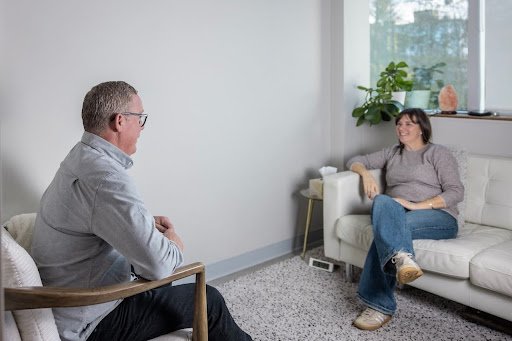
Your first session is about getting oriented, for both of you. Your counsellor will want to understand what brought you in, what your life looks like right now, and what you’re hoping to get out of this. You don’t need to have your story perfectly organized or know exactly what you want. That’s what the process is for. If there’s anything specific about how you’d like to be addressed, name, pronouns, language, just let your counsellor know. And if you forget or it changes, that’s fine too.
Our Collaborative Approach
This isn’t the kind of counselling where someone tells you what to do. Your counsellor works with you to figure out what matters, what’s getting in the way, and how to move toward a life that feels more like yours. Sometimes that’s processing difficult emotions. Sometimes it’s working through a specific decision. Sometimes it’s just having a place where you don’t have to perform or explain yourself. The work evolves as you do.

Confidentiality
Everything you share remains confidential within legal and ethical boundaries. Your counsellor will walk through all of this in your first session so there are no surprises. Whether you’re navigating disclosure in your personal life, at work, or within your family, your counselling space remains yours.

Flexible, Ongoing Support
Some people come weekly. Some come every other week. Some come intensively for a period and then space things out. There’s no single right cadence for this work. Your counsellor will check in with you about what’s working, and you can adjust as your needs change. You’re also welcome to step away and come back whenever you need to.
Frequently Asked Questions
Gender identity is about who you are, your internal sense of your own gender. Sexual orientation is about who you’re attracted to. They’re separate things, though they can intersect in complex ways. You don’t need to have both “figured out” to start counselling.
No. You don’t need a diagnosis, a referral, or even certainty about your identity. Some people come because they’re questioning. Some come because they’ve known for years but need support with the practical and emotional realities. There’s no threshold you need to meet.
We’re not here to assess or gatekeep. Some clinical settings treat gender identity work as an evaluation process, determining whether someone “qualifies” for certain steps. That’s not what we do. Our counsellors are here to support you in understanding your own experience and making decisions that feel right for you, without imposing external criteria.
No, and honestly, be cautious of anyone who would. Decisions about transition (social, medical, or otherwise) are deeply personal and only you can make them. What we can do is provide a space where you can explore those questions honestly, weigh what matters to you, and work through the fears or pressures that might be clouding things.
It varies enormously. Some people come for a few months to work through a specific challenge. Others find value in longer-term support as they navigate ongoing changes. We don’t set arbitrary timelines and we won’t push you out the door. This is your process.
Yes. We offer secure virtual counselling to anyone in British Columbia. Many clients find virtual sessions work well for this kind of work, especially if privacy is a concern or if you’re not near our Langley or Vancouver offices.
Tell us. The therapeutic relationship is the foundation of this work, and if something isn’t clicking, that matters. We can help you connect with another counsellor on our team, no awkwardness, no hard feelings. Your free initial consultation exists specifically to help reduce this risk.
Not here. We view your gender identity as a fundamental part of who you are, not a condition to treat. The things we work on together, distress, relationship strain, anxiety, body discomfort, those are the concerns. Your identity is the context, not the diagnosis.
Absolutely. Questioning is a completely valid reason to seek support. You don’t need a label or a conclusion before walking through the door. Counselling can be a space to sit with the uncertainty rather than rushing toward an answer.
If it’s on your mind enough that you’re reading this page, it’s worth exploring. There’s no minimum level of suffering required. And honestly, getting support earlier, before things build up, tends to make everything more manageable.