Moral Injury Counselling in Langley
When your actions, or someone else’s, violated something deep inside you, that wound doesn’t just go away on its own. You don’t need someone to tell you what happened was wrong. You already know. What you need is a space where you can actually face it, feel it, and find a way forward.
Serving Langley and the Lower Mainland since 2012
Moral Injury
You carry something heavy. Maybe it’s guilt over a decision you made under impossible pressure. Maybe it’s rage at a system or leader who put you in that position. Or maybe it’s a quieter kind of pain — the slow realization that what you witnessed or were part of crossed a line you didn’t even know you had until it was behind you.
Moral injury isn’t about what’s “wrong” with you. It’s what happens when your experiences collide with your deeply held sense of right and wrong. And unlike a lot of mental health challenges, it doesn’t always show up as a clinical diagnosis. It shows up as shame that won’t let go, as a loss of trust in others, in institutions, in yourself, and as the nagging feeling that who you were before is someone you can’t get back to.
Here’s the thing most people don’t hear enough: this kind of pain makes sense. It’s not weakness. It’s actually a signal that your moral compass is intact, even if the experience that wounded it was devastating. At Lavender Counselling, we don’t treat moral injury as something to “get over.” We see it as a deeply human response to impossible situations, one that deserves careful, relational attention rather than quick fixes or surface-level strategies

We offer moral injury counselling at our Langley offices and through secure virtual sessions throughout British Columbia. Whether you’re a veteran, a first responder, a healthcare worker, or someone whose moral injury came from a completely different context, we have counsellors who understand this work.
Challenges We Help With
Shame, Guilt & Self-Blame
- Replaying decisions over and over, wondering what you could have done differently
- Feeling fundamentally flawed or “broken” as a person because of what happened
- Struggling with the gap between who you thought you were and what you did (or didn’t do)
- Carrying guilt that feels disproportionate but impossible to shake
- Believing you don’t deserve good things or happiness anymore
Loss of Trust & Meaning
- Feeling betrayed by leaders, institutions, or systems that were supposed to have your back
- Questioning your faith, spiritual beliefs, or sense of purpose
- Losing trust in your own judgment or moral compass
- A pervasive sense that the world isn’t what you thought it was
- Feeling disconnected from values or beliefs that used to anchor you
Emotional & Psychological Impact
- Anger that feels bottomless, at yourself, at others, at the situation
- Emotional numbness or flatness where there used to be feeling
- Intrusive thoughts or memories about the event
- Difficulty feeling joy, connection, or hope
- Persistent feelings of worthlessness or self-contempt
Relationship & Social Effects
- Withdrawing from people you care about
- Difficulty being vulnerable or letting others in
- Feeling like nobody could understand what you’ve been through
- Irritability or conflict in close relationships
- Avoiding people or places connected to the moral injury
Daily Life Impact
- Trouble sleeping, or dreading the quiet that comes when you stop being busy
- Using alcohol, work, or other distractions to avoid sitting with the pain
- Loss of motivation or direction in your career or personal life
- Difficulty concentrating or making decisions
- Physical symptoms: headaches, tension, fatigue, stomach issues
How We Support Moral Injury
We approach every person and every story as unique. Moral injury is deeply personal. What wounded you, how it shows up, what healing looks like, none of that follows a formula. So we don’t use one.
Get to Know the Problem
Before anything else, we need to understand what actually happened and what it means to you. Not what a textbook says moral injury looks like, but what yours looks like. Your counsellor will take time to hear your story, the full, complicated, messy version of it, without rushing toward solutions or judgment.
“The hardest part isn’t the event itself. It’s the story you’ve been telling yourself about who you are because of it.”
Assess the Root Cause
Moral injury often gets tangled up with other experiences, trauma, grief, betrayal, burnout. Sometimes it sits underneath depression or anxiety for years before anyone names it. We work to identify what’s actually driving the pain, which often means looking at the beliefs and values that were violated, the context you were in, and the relationships or systems that played a role.
“Naming what happened , without minimizing it and without drowning in it , is where the change begins.”
Treat From the Bottom Up
Moral injury doesn’t just live in your thoughts. Research on shame and guilt, particularly in military and first responder populations shows these experiences register in the body. Shame activates the autonomic nervous system differently than fear, often producing a kind of collapse or withdrawal response rather than the fight-or-flight pattern people associate with trauma. That’s why talk alone sometimes isn’t enough. Our counsellors may integrate body-aware and somatic approaches alongside relational work, helping you process what your body is holding alongside what your mind keeps replaying.
“You can’t think your way out of something your whole body remembers.”
Our Approach Helps You:
✓ Understand your moral injury as a meaningful response, not a character flaw
✓ Rebuild a relationship with yourself that includes what happened, without being defined by it
✓ Reconnect with your values and sense of purpose on your own terms
✓ Develop the capacity to sit with difficult emotions rather than numbing or avoiding them
Our Counselling Team
Our team includes registered clinical counsellors who work with moral injury. Each brings unique training and expertise in evidence-based modalities including:
- Trauma-informed and person-centred therapy
- Attachment-based and relational approaches
- Somatic and body-centred practices
- Mindfulness and self-compassion-based approaches
- Experiential and emotion-focused therapy
Our therapists works with:
- Teens, adults, and couples navigating moral injury
- Veterans, military members, and their families
- First responders and healthcare workers
- Teachers, caregivers, and other helping professionals
- Anyone whose experiences have violated their deeply held moral beliefs
Find Your Moral Injury Counsellor
The right therapeutic relationship is essential for moral injury work. This isn’t the kind of thing you can process with just anyone, you need someone who gets it and who you feel safe with. Use our therapist selector tool to find counsellors whose expertise, approach, and availability match what you’re looking for.
Why Choose Lavender Counselling for Moral Injury?
Relational, Person-Centered Approach
Bottom-Up, Body-Based Support
Find Your Perfect Fit
Consistent, Quality Care
No Artificial Timelines
Flexible Access
Insurance Coverage
Deep Community Roots
What To Expect In Moral Injury Counselling

Your First Session
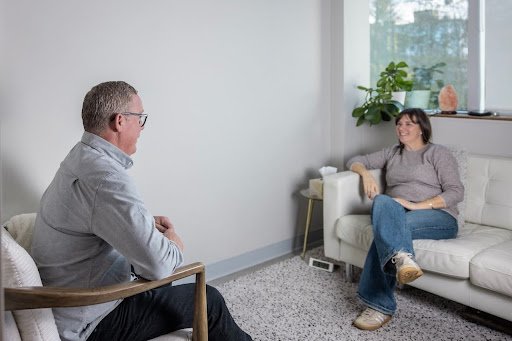
Your first session is really about getting to know each other. Your counsellor will want to understand what brought you in, what you’re carrying, and what you’re hoping for, but there’s no pressure to share everything right away. Moral injury work requires trust, and trust takes time. You’ll also have the chance to ask questions and get a feel for whether this relationship feels right.
Our Collaborative Approach
Therapy for moral injury isn’t something that’s done to you, it’s done with you. Your counsellor won’t hand you a worksheet and send you on your way. Instead, you’ll work together to explore what happened, what it meant, and how you want to move forward. Some sessions will be heavy. Some might surprise you. The pace is yours.

Confidentiality
Everything you share remains confidential within legal and ethical boundaries. Your counsellor will walk through all of this in your first session so there are no surprises. For moral injury work specifically, this confidentiality matters, many people carry shame about what happened, and knowing that your story stays in the room can make it safer to actually tell it.

Flexible, Ongoing Support
Some people come weekly. Some come every two weeks. Some take breaks and come back. There’s no right way to do this, and we won’t impose a rigid schedule. What matters is that the work happens at a pace that feels sustainable for you.
Frequently Asked Questions
Moral injury happens when you experience, witness, or fail to prevent something that violates your deeply held moral beliefs. It was originally identified in military contexts, but it can happen to anyone, healthcare workers making impossible triage decisions, first responders who couldn’t save someone, people who were put in positions where every option felt wrong. It’s the wound that comes from having your sense of right and wrong shattered by reality.
No, though they can overlap. PTSD is rooted in fear, the nervous system’s response to a perceived threat to your safety. Moral injury is rooted in shame, guilt, and a sense of betrayal, it’s about meaning, not danger. Someone can have both, or one without the other. The distinction matters because the treatment approach is different. Moral injury often requires more focus on values, identity, and relational trust than traditional trauma processing alone.
We take a relational, person-centred approach rather than relying on protocol-driven treatment. That means we’re not running you through a set number of sessions with a predetermined structure. Instead, your counsellor works with you to understand the specific nature of your moral injury, what it’s touched in your life, and what kind of support actually fits. We may also integrate body-based awareness because moral injury doesn’t just live in your head.
Absolutely. While the term originated in military research, moral injury can happen in any context where your deeply held values are violated. Healthcare workers, teachers, clergy, people in abusive relationships, those who’ve worked in morally compromising organizational cultures, the list is long. What matters isn’t the category you fit into; it’s the wound itself.
There’s no honest one-size-fits-all answer. Some people find meaningful relief in a few months. Others need longer, especially if the moral injury is layered with other experiences like trauma, grief, or systemic betrayal. We don’t impose timelines, the work takes as long as it takes.
Yes. We offer secure virtual counselling throughout British Columbia. Many of our clients find virtual sessions work well for this kind of deeply personal work, being in your own space can sometimes make it easier to go to difficult places.
That’s okay. You don’t need a label to start. If you’re carrying guilt, shame, anger, or a sense of lost meaning connected to something you experienced, that’s enough to bring to counselling. Your therapist can help you make sense of what you’re going through, whether it ends up being moral injury, trauma, grief, or something else entirely.
Tell us. This is sensitive, deeply personal work, and the therapeutic relationship is everything. If your counsellor isn’t the right match, we’ll help you connect with someone else on our team or refer you elsewhere. No hard feelings, no awkward conversations. The fit matters more than anything.
If it’s still affecting you, it’s enough. Moral injury doesn’t have a severity threshold. Some of the most painful moral injuries come from situations that might look unremarkable from the outside but were devastating on the inside. You don’t need to justify your pain to anyone, least of all your therapist.